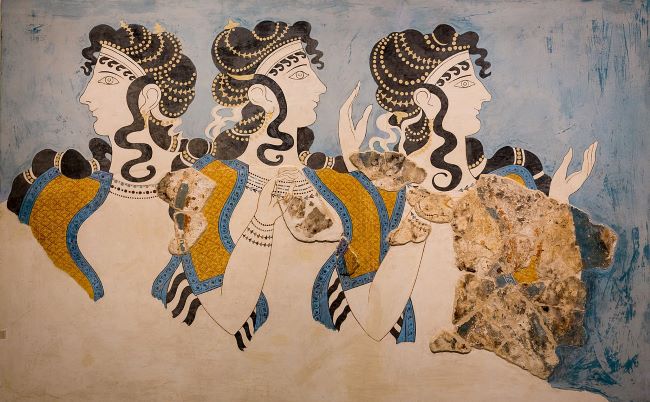
Goddess Pilgrimage to Crete

I am in the process of booking a two-week tour in Crete on a Goddess Pilgrimage led by Carol P. Christ. Carol has met Marija Gimbutas, the world’s foremost authority on Old Europe.

I based a lot of my vision of the people I am writing about on Marija’s archeological work and interpretation. Marija coined the phrase “Old Europe” to refer to a time from 7000 BCE to 1700 BCE_— approximately the time of the first farming societies in Europe and usually referred to as the stoneage. This is the time in Europe when the Neolithic peoples erected the megaliths and is the time period in which my book is set. Marija was unique in that she combined folklore with her archeological excavations when interpreting her findings. She characterized this culture as peaceful, matrilineal, goddess centered and agrarian, and she made a start at translating the pictographs of the region.

            Although my book is set in the Carnac/southeastern Ireland/southwestern England region, this culture occupied all of modern day Europe. In Crete, these “Old Europeans” were permitted to keep their culture for a longer period of time than the rest of Europe, and there are many well preserved archeological sites existing there. It is here that I hope to be able to stand inside the walls of a dwelling ruin and get the sense for the space and living habits of these ancient people. I also hope to learn the myth and folklore of the region and modern day practices as they reflect the origins of the place. This will help me form a clearer picture of the society thus enabling me to bring the society back to life in my book.

            The tour includes a visit to the Heraklion Archaeological Museum, Sacred Myrtle Tree, Tholos Tomb at Kamilari, Museum of Cretan Ethnology in Vori, Archeological Museum of Archanes, Skoteino Cave, archaeological site of Mochlos Island, ritual of the Labyrinth and many other caves, sacred sites, archaeological sites and museums.

            The tour will be the last leg of my exploration for my book as it takes place from September 29th to October 13. Which leads into the practical issue of time in Europe before needing a visa.

            I was under the impression that I could only stay in Europe for 3 months without a visa, but my sister-in-law put me on to the schengen. Greece is part of the schengen and so is France, but Ireland and England are not. Therefore I can spend time in the non-schengen countries before entering France. I just need to ensure I will be leaving Greece within 90 days of entering France.

            Today I will try to book the rest of my stay in Ireland.
Article in the Peninsula News Review by Steven Haywood

Sidney author sells everything for two-year book research trip
Writer and blogger Ruth Wellburn to explore Europe’s ancient standing stone sites.
STEVEN HEYWOODThu Apr 27th, 2017 ENTERTAINMENT
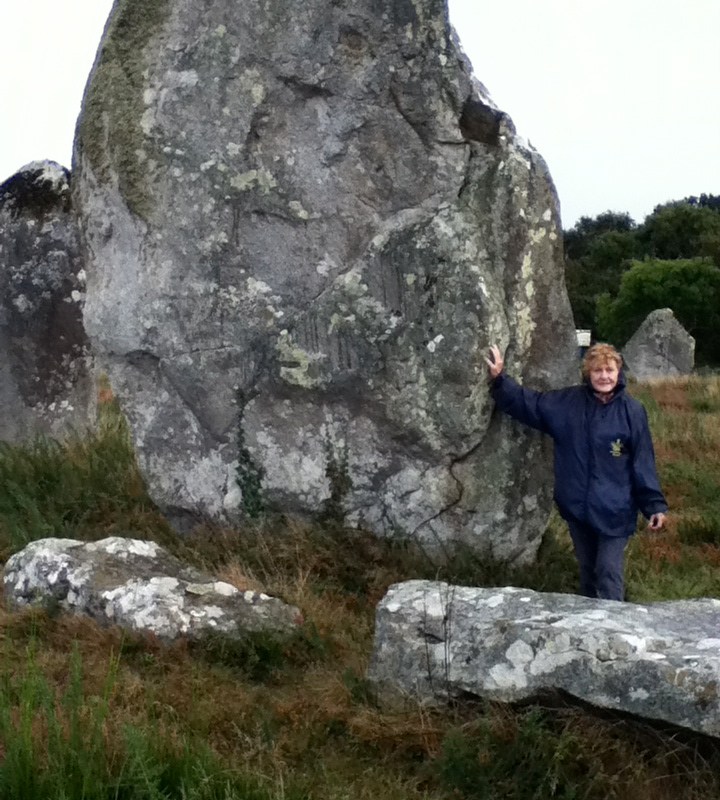
Sidney author Ruth Welburn at the standing stones at Carnac, France during a trip she took to the area a few years ago. She plans on returning there as part of her research for a new work of fiction. Submitted

Ruth Welburn has sold her home in Sidney, her car and is in the process of either storing or getting rid of many of her possessions.

For the local author, it’s all part of her long-term plan to research some of Europe’s prehistoric history for a new work of historical fiction. It has been a dream of hers to leave behind the shackles of day-to-day life and spend up to two years overseas, exploring and getting to know the local culture and folklore surrounding some of the most mysterious objects in the world.

Welburn, a writer and blogger and author of two books The Devil’s Ruse and children’s book Bed Bug’s Big Adventure, got the idea for her next tale while she was in Europe five years ago, touring the Way of St. James — or the Camino Trail. While she was in France, she stopped to see the village of Carnac in Brittany, the largest Neolithic site in the world, whose standing stones are older than those at Stonehenge, in England.

“I couldn’t believe what I saw,” she says. “Everything there is written in stone and it’s just amazing what they knew.”

That early knowledge of mathematics, the earth and the cosmos sparked in her imagination what life might have been like during the Neolithic era (3300 BC).

“I have spent the last five years trying to figure out who those people were and where they came from.”

Welburn said she’s done a lot of reading on the subject of Europe’s standing stones and the people who erected them. She said much of that history is a mystery. For her book — whose working title is The Land of Uriel — Wellburn said she plans to travel first to Ireland and visit Newgrange, a prehistoric monument. A large, circular mound with stone passageways and chambers, it dates back the neolithic as well and is also older than Stonehenge and the Egyptian pyramids.

Welburn’s travels will eventually take her across to England and Stonehenge, then over to France and Carnac, where she will spend the bulk of her time — about three weeks. Then, she said she plans on taking a ferry over the Belle Isle En Mer, not too far from Carnac, where she will spend a month writing. She said a little bit of isolation is what she needs to work on her story.

“That’s when I will write and formulate my words a little better.”

During her travels, Welburn said she plans to get to know the areas where these standing stones and Neolithic monuments were created. Immersing herself in the local culture and folklore, she said, will help add colour to her writing.

“When I had gone to walk a portion of the Camino, and visited Carnac, I felt there was something ancient in me that I wanted to discover.”

She hopes spending time there will tap into her unconscious and help bring together her experiences and the area’s history, into her new work.

“I really need to go and listen to the echos,” she said. “There’s something more out there than just what you see.”

Welburn added she will be using her blog — followthewriterblog.wordpress.com — to tap into people, stories and information about the Neolithic sites. She’s already been receiving advice about where to go in each of the countries she plans on visiting.

Welburn is looking at being on the road for 24 months in all, after leaving Sidney at the beginning of May. She will stop first in eastern Canada to visit her family. From there, it’s a solo journey to Dublin, Ireland and prehistoric sites beyond.

Will she return to the Saanich Peninsula when she’s done?

“I’m not sure,” she admits. “After two years, I’m not sure where I might land. Two years is as far ahead as I can think at the moment.”