We are told that Stonehenge is a mystery and that we cannot understand how primative people could have built it. I would like to put forward for consideration the idea that we can understand. We just need to shed false biases.
One would have to believe in the Great Year for things to fall into perspective. Civilization on Earth descended to an all-time low about 2,000 years ago. We are advancing now, but we will not be back to where we were in 9,500 BCE for another seven and a half thousand years. Indeed, it will be close to 2,000 years before we achieve the advanced level of the Stone Age people I fictionalize in Land of the Watchers.
PROLOGUE
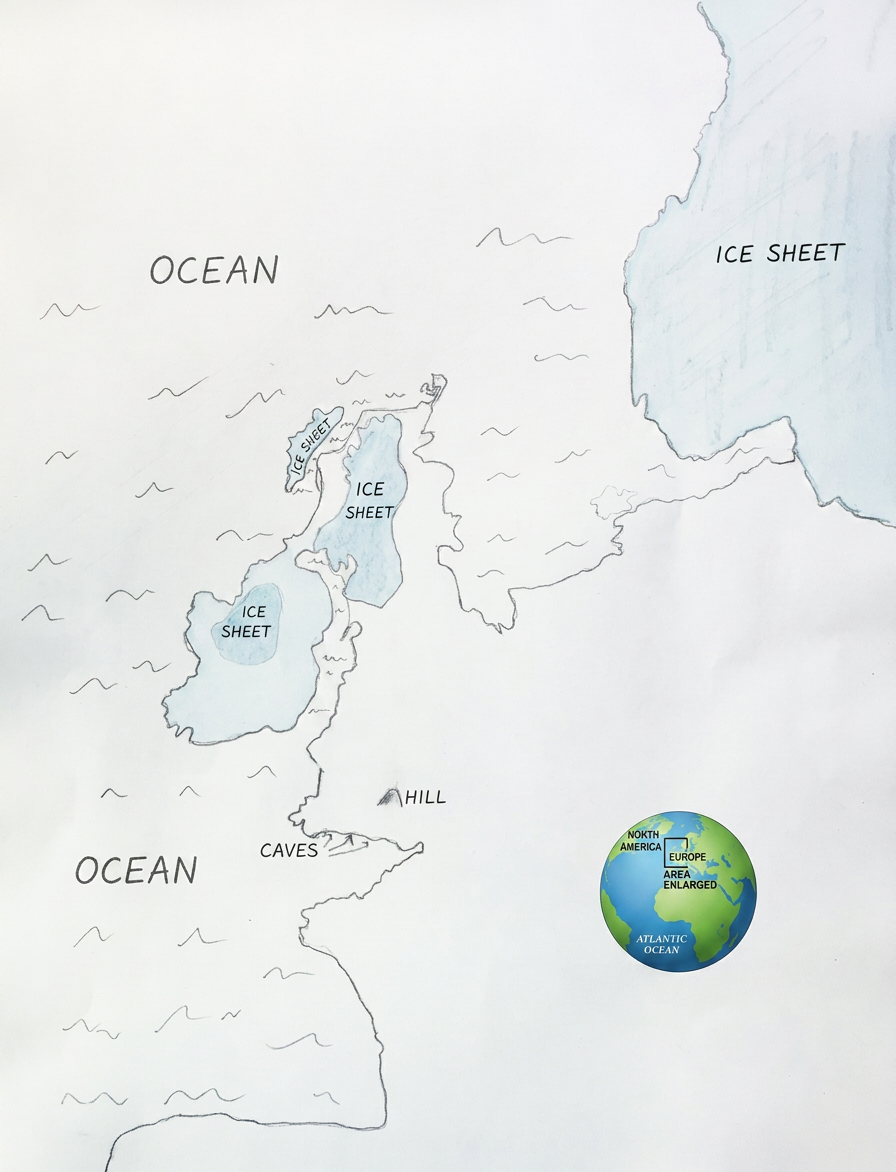
The prologue takes place in the fall of 7640 BCE on a hill in what is now Avebury, England. At the time, large ice caps existed, sea levels were lower, and Europe was one landmass. My characters have fled inland from their caves on the south shore to higher ground. They see a fireball in the sky that is about to strike Earth, and, having been bombarded by many smaller meteorites in the past, fear that a tsunami could wipe them out if it were to strike down in the ocean near them.
The people in the prologue lived over four thousand years before Land of the Watchers begins. And those ancient ancestors of the people in my novel recount a legend of a time thousands of years earlier, when a chunk of debris as large as Earth itself flew by Earth and its Moon. It didn’t hit them, but it flew so close that its gravitational pull unleashed unimaginable upheaval. These ancient people feared that such devastation could recur.
Nothing is stationary in space. The Moon circles around an Earth that spins on its axis while travelling around the Sun. The ancients also believed that our Sun travels around a much larger orbit in the Milky Way, giving us twelve ages that each span about 2000 years. They called this cycle the “Great Year” because this journey takes 26,000 years to complete.
For a celestial body to move through space, it must have another gravitational object to swing around. The ancients believed that the small, dim, dying star that orbits Sirius, designated Sirius C, travels back and forth around another 26,000-year orbit from Sirius through the Milky Way to where it swings around the outer edge of our solar system. The people in Land of the Watchers believed that Sirius C is our unseen second sun! The Norte Chico people of ancient Peru also believed this. You will meet the Norte Chico in chapter five.
The prologue shows what happened in the distant past that caused the people of my novel, Land of the Watchers, to attach such great importance to astronomy, motherhood, and agriculture. These ancestors tell the story of what happened in 9500 BCE, during our last Golden Age. Our Sun is dragging its planets with it around its long orbit in space when it passes through a debris field of a supernova. Many fragments from the exploding star streak past, but some enter our solar system. As Martin Gray explains on Knowth’s website, https://www.knowth.com/sacred-geography-1.htm, one such piece, as large as Earth itself, passes close to Neptune, sending one of Neptune’s moons out to the far edge of our solar system. That moon is now known as the planet Pluto. As it continues to travel deeper into our solar system, the invading debris passes Saturn and sends one of its moons into planetary orbit around the sun. That planet is known today as Mercury. Then the boloid crashes into a planet between Mars and Jupiter, smashing it to smithereens and sending rock and ice shooting out in all directions. Pieces of that planet bombarded Earth for thousands of years.
And, this large chunk of the supernova was not done wreaking havoc with our solar system. Before plunging into our sun and being consumed, it flew close by Earth and its Moon. Its gravitational pull sent our moon spiralling off course and caused Earth to tilt on its axis. In time, our moon settled into an orbit closer to Earth. Tides were higher, solar flares more intense, magnetic fields weakened before they reversed, Earth’s crust shifted, and its belly ruptured and spewed out molten rock. Fires engulfed the land, ice sheets melted, sea levels rose, and continental landscapes were reshaped. The number of people, animals, plants, and all that flew above, crept, or walked on Earth diminished. Many disappeared forever.
Graham Hancock, in Magicians of the Gods and Fingerprints of the Gods, asserts that a global catastrophe wiped out an advanced, prehistoric human civilization around 9500 BCE and that its survivors built Göbekli Tepe. This annihilation is also chronicled in Greek mythology and mentioned by Plato.
Science supports the many mythological accounts of this happening. In his book, Ice Age Civilizations, James Nienhuis cites compelling scientific evidence of this 9500 BCE cosmic catastrophe, as do Allan and Delair.
In his post on Knowth’s website, Martin Gray writes:
The ancients believed that the past was not simply a memory but a forewarning of what might lie ahead.
Indeed, that prophecy came true in the fall of 7640 BCE, almost two thousand years after the devastating fly-by.
The prologue tells the story of the 7640 BCE strike from the perspective of the people who lived on Earth at that time. That catastrophe was still recounted 4,000 years later during the time of Land of the Watchers. This holocaust explains why the people in my fiction study the skies. They are afraid that they will be hit again by a cosmic body.
Mythological accounts from many parts of Europe tell of bright new stars that fell to earth as seven flaming mountains, oceans that rose up in towering waves and surged over the land, and how summer was driven away for a very long time, leaving only cold darkness. Similar myths exist in places all around the world.

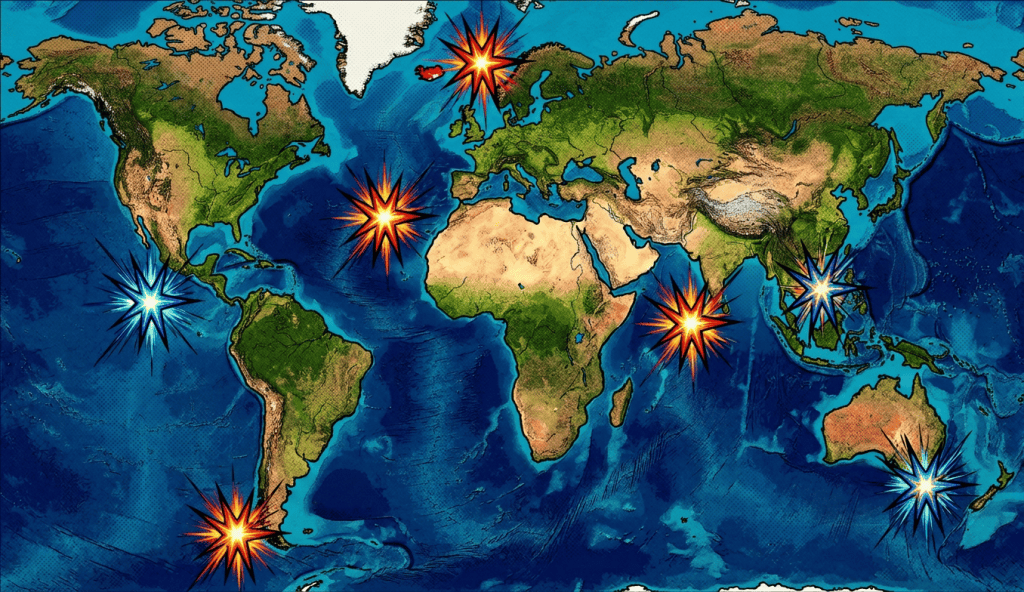
Geology provides solid evidence that in the fall of 7640 BC, a bolide from the sky broke apart into seven pieces and splashed down into all seven oceans. This caused untold destruction on Earth, including the reversal of the Earth’s magnetic field.
In a paper published in Terra Nova in 1994, Austrian paleontologist Edith Kristan Tollmann and her husband, geologist Alexander Tollmann, postulate that one huge comet broke apart on entry and struck down in all seven oceans around 7640 years BCE. They believe this might explain early Holocene extinctions and possibly legends of the Universal Deluge.
The Tollmanns cite stratigraphic studies of tektites, dendrochronology, and Greenland ice cores containing hydrochloric and sulfuric acids that advocate for an energetic ocean strike. Nitric acids were also found, indicating an extreme heating of the air.
Indeed, many of the highest mountains in England, Scotland and Ireland are littered with beds of sand and gravel containing sea shells. This finding supports mythological accounts of vast waves covering the land.
Christopher Knight and Robert Lomas, in their book Uriel’s Machine, assert that the 7640 BCE evidence is consistent with the dates of formation of several salt flats and lakes in dry areas of North America and Asia. They argue that these lakes were created by waves several kilometres wide that penetrated deep into continents as a result of oceanic strikes.
Indeed, Charles H. Hapgood, in his book Maps of the Ancient Sea Kings, describes a time very long ago when a lost civilization more advanced than ours used spherical trigonometry to determine Earth’s longitude. The longitude problem at sea was only solved in modern times in 1761 by means of a clock. Yet the Piri Re’is maps show accurate cartographical evidence of knowledge of longitudinal coordinates. The Piri Re’is map even shows Antarctica before it was buried under ice. Could this map be further evidence of an earth-altering event in 9500 BCE?
Christopher Knight and Alan Butler, in their book The Hiram Key, also assert that the Neolithic people of my fiction, Land of the Watchers, knew the polar and equatorial circumferences of the Earth to an accuracy of a few meters.
The opening chapter of Land of the Watchers unfolds 6,350 and 3,590 years respectively, prior to the commencement of the main narrative. It details an era when Earth suffered the wrath of cosmic forces. This turmoil explains the motivations and capabilities of the characters in my novel. Their comprehension of the Great Year and the existence of our second sun, Sirius C, would explain why they built Newgrange.
The nonfiction companion book explains that three and a half thousand years before the story in Land of the Watchers begins, seven colossal meteorites impacted Earth. And Earth had been bombarded by debris from the heavens for thousands of years before that. Those impacts caused worldwide extinctions, acid rain, ten years of cold, darkness, and more. It would, therefore, make sense that the people in my novel, living in the year 3150 BCE, paid so much attention to studying the skies and why agriculture and motherhood were so important to them. They would not have wanted to pick plants, gather eggs, or kill animals that were struggling to survive. Indeed, they were fighting against their own possible extinction.
The Stone Age people of my novel would need to work together to survive. Thus, they shunned possessions in favour of fellowship with each other. In their attempt to help other people, plants, and animals survive, genetics would have further perpetuated their nurturing personality through a process called epigenetics.
They would have built communities around springs, considering them “Holy Wells” because they provided potable water. And they would have embedded large, magnetic stones in the ground, like giant acupuncture needles, to stabilize the molten lava currents that flow beneath Earth’s crust and allow migratory birds and insects to find their way. Indeed, in his book, The Mysteries of Carnac, Markal wrote:
… prehistoric builders did not place standing stones at random. Instead, they positioned them precisely along telluric lines (natural earth currents) to channel energy and balance tectonic stresses.
The two historical disasters likely shed light on why the diet of the Stone Age people of Northwestern Europe predominantly consisted of seafood, dairy products, and agricultural items. Pork was eaten, but only on festive occasions. This diet, low in red meat, would account for the anemia and deficiencies in iron and vitamins observed in excavated bones. It would also explain the prevalence of erythrocytosis among the populations of the UK and Ireland today. Their body would produce excess red blood cells to counter the lack of iron.
The fact that an advanced culture, with knowledge and technology superior to ours, was lost during the flyby of 9500 BCE would account for how the Stone Age people of my book were able to accomplish such monumental feats. The advanced civilization from the Golden Age may have been destroyed, but their understanding and skill lived on. Perhaps the Watchers were survivors of this erudite society.
Charles H. Hapgood said something interesting at the beginning of his book, Maps of the Ancient Sea Kings.
… Most breakthroughs have been opposed by experts in their field. Copernicus, Newton, and Darwin were all amateurs when they made their discoveries.
… Learning what everyone else has done before you (is) not likely to initiate anything new.
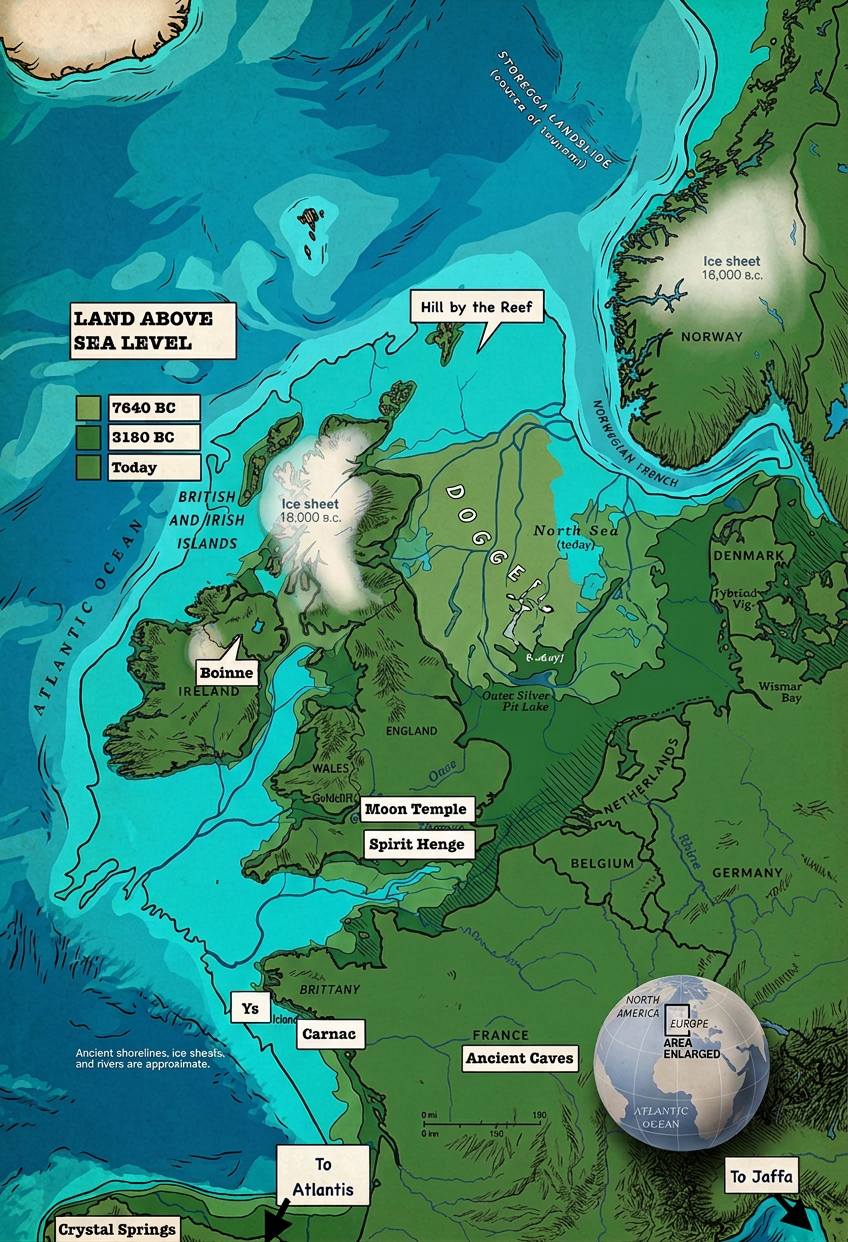
The above sketch shows northern Europe as it was at the time of my fiction.


You must be logged in to post a comment.